
Course : Authority and Leadership from Thucydides to Adam Smith
LEPE1 - Despina Vertzagia, Georgios Steiris, Spiros Tegos
-
Display all units
-
I. Introduction: Authority, Power, and Political Leadership
-
II. Thucydides and Xenophon: Political Leadership, Power, and the Art of Ruling
-
III. Plato and Cicero: Political Knowledge, Virtue, and Auctoritas
-
IV. The Machiavellian leader 1
-
V. The Machiavellian leader 2
-
VI. The Machiavellian leader 3
-
VII. Thomas Hobbes: Authorization, Sovereignty, and Political Obligation
-
VIII. Authority of the assembly and democracy in the work of John Adams
-
IX. Authority of the institutions of the Old Regime and the authority of the new republican institutions during the French Revolution
-
X. Authority, power, and the common interest in political systems according to David Hume
-
XI. Authority, power, and the common interest in political systems according to Adam Smith
-
XII.
-
I. Introduction: Authority, Power, and Political Leadership
VII. Thomas Hobbes: Authorization, Sovereignty, and Political Obligation
Unit overview
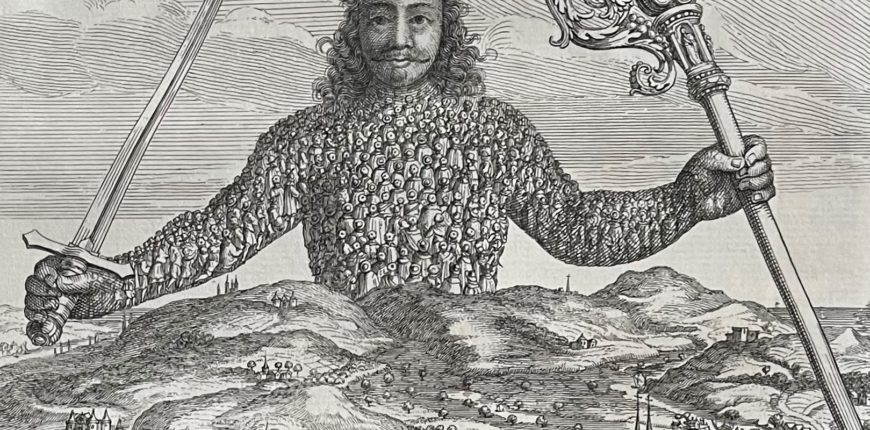
This final unit examines the transformation of political authority in early modern political philosophy through the writings of Thomas Hobbes. Particular attention is devoted to Hobbes's engagement with classical political thought, especially his translation and interpretation of Thucydides, and to his distinctive account of sovereignty and political obligation.
The unit begins with Hobbes's conception of the state of nature, examining the relationship between natural equality, competition, fear, self-preservation, and the insecurity of human existence in the absence of a common political power. It considers the circumstances that make the establishment of political authority necessary and the conditions under which individuals can escape the insecurity of the natural condition.
The discussion subsequently investigates the social contract and the process of authorization through which individuals establish a sovereign representative capable of securing peace and political order. Central to this analysis is Hobbes's distinction between the author and the actor, as well as his understanding of political representation and the artificial unity of the commonwealth.
The unit also explores the relationship between sovereignty, obedience, and protection, considering the grounds and limits of political obligation and the distinctive character of sovereign authority.
Particular attention is devoted to Hobbes's engagement with classical political philosophy. His translation of Thucydides provides an opportunity to reconsider the relationship between political judgment, democracy, and the dangers of political conflict.
The unit also examines the interpretation of Hobbes as a founding figure of modern political liberalism, exploring how the primacy of individual self-preservation and natural rights can be reconciled with his defence of absolute and indivisible sovereignty, and whether this apparent tension reveals a fundamental paradox at the origins of liberal political thought.
Keywords
Thomas Hobbes; state of nature; natural equality; fear; self-preservation; social contract; authorization; representation; sovereignty; political obligation; obedience; political legitimacy; security; liberalism
Required readings
-
Hobbes, Thomas. Leviathan, chapters 13–18 and 21.
-
Hobbes, Thomas. "Of the Life and History of Thucydides." In Eight Bookes of the Peloponnesian Warre, 1629.
Complementary readings
-
Hobbes, Thomas. On the Citizen (De Cive), chapters 5–6.
-
Strauss, Leo. The Political Philosophy of Hobbes: Its Basis and Its Genesis. Translated by Elsa M. Sinclair. Oxford: Clarendon Press, 1936.
-
Skinner, Quentin. Hobbes and Republican Liberty. Cambridge: Cambridge University Press, 2008.