
Course : Authority and Leadership from Thucydides to Adam Smith
LEPE1 - Despina Vertzagia, Georgios Steiris, Spiros Tegos
-
Display all units
-
I. Introduction: Authority, Power, and Political Leadership
-
II. Thucydides and Xenophon: Political Leadership, Power, and the Art of Ruling
-
III. Plato and Cicero: Political Knowledge, Virtue, and Auctoritas
-
IV. The Machiavellian leader 1
-
V. The Machiavellian leader 2
-
VI. The Machiavellian leader 3
-
VII. Thomas Hobbes: Authorization, Sovereignty, and Political Obligation
-
VIII. Authority of the assembly and democracy in the work of John Adams
-
IX. Authority of the institutions of the Old Regime and the authority of the new republican institutions during the French Revolution
-
X. Authority, power, and the common interest in political systems according to David Hume
-
XI. Authority, power, and the common interest in political systems according to Adam Smith
-
XII.
-
I. Introduction: Authority, Power, and Political Leadership
III. Plato and Cicero: Political Knowledge, Virtue, and Auctoritas
Unit overview
This unit investigates the philosophical and institutional foundations of legitimate political authority through a comparative examination of Plato and Cicero. It focuses on the relationship between political knowledge, virtue, law, tradition, and the justification of political rule.
In Plato's Republic and Statesman, political leadership is examined in relation to the distinction between knowledge and opinion, the education of rulers, and the claim that genuine political authority requires an understanding of the common good. Particular attention is devoted to the philosopher-king, the relationship between philosophical wisdom and political power, and the tension between political expertise and the demands of political life. The discussion raises fundamental questions concerning whether superior knowledge provides a sufficient justification for political rule, whether philosophical wisdom can be reconciled with the practical requirements of governing, and to what extent political authority should be exercised through established laws and institutions.
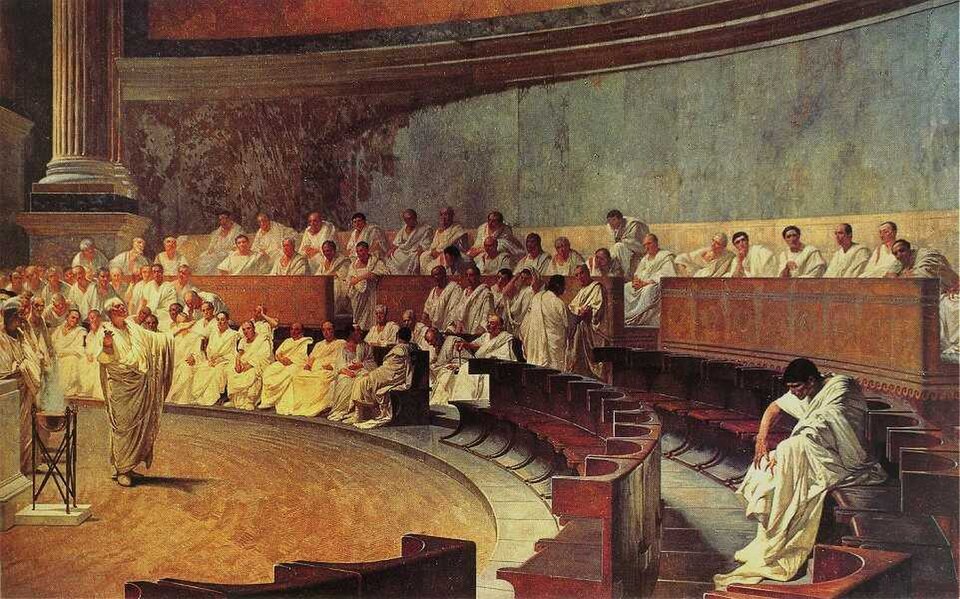
The unit subsequently turns to Cicero's republican political thought, examining the relationship between political authority, constitutional order, and inherited tradition. Central to this discussion is the Roman concept of auctoritas, understood in relation to potestas, imperium, and the mos maiorum. Particular attention is devoted to the distinction between the possession of legally constituted power and the recognition of political authority grounded in experience, public service, institutional standing, and established customs.
Through Cicero's conception of the Roman Republic, students explore the distinctive role of senatorial authority and the relationship between personal virtue, practical judgment, public responsibility, and institutional legitimacy. The discussion also considers the importance of constitutional arrangements and inherited political traditions in preserving the stability and continuity of the political community.
The comparison between Plato and Cicero highlights two different, though not necessarily incompatible, approaches to the justification of political authority: the philosophical claim that legitimate rule requires superior knowledge and the republican emphasis on institutional continuity, practical judgment, and recognized political standing. By examining these approaches together, the unit invites students to consider whether political authority ultimately derives from the wisdom and virtue of those who govern, from the legitimacy of political institutions, or from the relationship between the two.
Keywords
political authority; political knowledge; knowledge and opinion; philosopher-king; political virtue; justice; common good; legitimate rule; philosophy and politics; political expertise; republicanism; auctoritas; potestas; imperium; mos maiorum; constitutional order; institutional legitimacy
Required readings
-
Plato. Republic, Books V–VII, especially 473c–480a and 484a–487a.
-
Plato. Statesman, 292e–303b.
-
Cicero. De re publica, Books I–II.
-
Cicero. De legibus, Book III, especially 3.28.
Complementary readings
-
Atkins, Jed W. Cicero on Politics and the Limits of Reason: The Republic and Laws. Cambridge University Press, 2013.
- Bloom, Allan, trans. The Republic of Plato. 2nd ed. New York: Basic Books, 1991. "Interpretive Essay."
-
Strauss, Leo. The City and Man. University of Chicago Press, 1964. Chapter II, "On Plato's Republic."