
Παρουσίαση/Προβολή
1897: A Year in Gothic
(ENL694) - Τατιάνα Κοντού
Περιγραφή Μαθήματος
1897: A Year in Gothic
Focusing on one single year of the late nineteenth century, this course explores the relationships between a blood-sucking count, a shapeshifting priestess of Isis, a psychic vampire, an invisible scientist, a ghost-hunting journalist and Sigmund Freud. We read a variety of popular Victorian gothic texts alongside Freud’s theories on dream interpretation and consider the many ways that gothic literature and psychoanalysis share common concerns and ways of thinking and talking about self and other, dream and desire, fear and release. Through fictional texts such as Bram Stoker's Dracula, Richard Marsh's The Beetle, Florence Marryat's The Blood of the Vampire and H. G. Wells's The Invisible Man, we consider gothic responses to technological and scientific progress, and geopolitical instability. The texts we study were published or completed in 1897, so we use this calendar year as our orientation point to think through the many ways that gothic literature and psychoanalysis engage with realism and reality, with being in time, and feeling in and out of it.
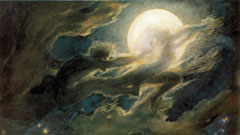
Course Image: Richard Riemerschmid, Cloud Ghosts (1897), egg tempera on cardboard, w77xh45 cm. Google Arts and Culture
Ημερομηνία δημιουργίας
Σάββατο 13 Δεκεμβρίου 2025
-
Περίγραμμα
1897: A Year in Gothic Course Syllabus
Figure 1. Philip Burne-Jones, The Vampire [1897]
Course Leader: Tatiana Kontou
Email: tkontou@enl.uoa.gr
Office: HUB 802
Tel. 210 727 7902
Office Hours: Monday 12:00pm-1:00pm & by appointment via email
Course Description:
Focusing on one single year of the late nineteenth century, this course explores the relationships between a blood-sucking count, a shapeshifting priestess of Isis, a psychic vampire, an invisible scientist, a ghost-hunting journalist and Sigmund Freud. We read a variety of popular Victorian gothic texts alongside Freud’s theories on dream interpretation and consider the many ways that gothic literature and psychoanalysis share common concerns and ways of thinking and talking about self and other, dream and desire, fear and release. Through fictional texts such as Bram Stoker's Dracula, Richard Marsh's The Beetle, Florence Marryat's The Blood of the Vampire and H. G. Wells's The Invisible Man, we consider gothic responses to technological and scientific progress, and geopolitical instability. The texts we study were published or completed in 1897, so we use this calendar year as our orientation point to think through the many ways that gothic literature and psychoanalysis engage with realism and reality, with being in time, and feeling in and out of time and place.
Required Texts:
Links to open-source texts will be provided on e-class and are cited below. When using a digital copy, please bring your computer or tablet toclass and use a note-taking application so you can make marginal annotations/notes that are easily accessed in class. You may also wish to acquire your own printed copies of the primary texts which include scholarly introductions and extensive editorial comments. Recommended printed editions are listed in parenthesis.
- Richard Marsh, The Beetle: A Mystery [Broadview Press, ISBN: 9781551114439/ 1551114437]
https://www.gutenberg.org/ebooks/5164
- Bram Stoker, Dracula [Oxford World’s Classics, ISBN: 9780192833860]
https://www.gutenberg.org/files/345/345-h/345-h.htm
- Florence Marryat, The Blood of the Vampire
https://www.gutenberg.org/ebooks/68277
- G. Wells, The Invisible Man: A Grotesque Romance [Oxford World’s Classics, ISBN: 9780198702672]
https://www.gutenberg.org/files/5230/5230-h/5230-h.htm
- Sigmund Freud, The Interpretation of Dreams [Oxford University Press, ISBN: 9780199537587]
https://www.gutenberg.org/files/66048/66048-h/66048-h.htm
Figure 2. Illustration from Andrew Lang's The Pink Fairy Book [1897]
Aims and Objectives:
Critically examine the gothic genre exploring its formal structures, aesthetic qualities, and cultural significance across different forms of writing, discourse, and media in one single year in the nineteenth century.
Engage in the close study of five emblematic texts of late nineteenth-century literature and culture, and develop skills to independently interpret them.
- We will research and understand the historical and cultural context of the fictional texts we are studying and evaluate the gothic’s potency and multivalency in engaging with and metabolizing cultural and political shifts, technological and scientific advancements, affects and feeling.
- We will hone close reading skills alongside relevant critical and theoretical approaches, understanding the gothic’s relationship to realism and other literary genres.
- We will discuss the gothic genre as a heuristic for the development of psychoanalytic theories.
Assessment:
Assessment rubrics will be uploaded on e-class. Your final grade in the course will be determined as follows:
- OPTION A: Final Exam 100%
You will be asked to answer two essay questions drawing on the texts, theories and cultural context studied on the course.
- OPTION B:
- Midterm 40%
You will respond to one essay question on texts, theories and cultural contexts studied up to and including week 7.
- Final Exam 60%
You will be asked to answer two essay questions drawing on texts studied on the course from week 8 up to and including week 13.
Students also have the option for extra credit by producing a critical reflection essay based on their commonplace book entries. Details for this asignment are at the end of the weekly schedule on the syllabus.
Figure 3. Lucien Levy Dhurmer, La burrasque [1897]
Class Policies:
Participation and Attendance:
As a seminar, this course is largely based on active participation, the quality of which depends on your preparedness and willingness to engage in class discussion (the golden rules: come to class with at least two comments to make about the subject at hand, be an active listener and respond thoughtfully and respectfully to the comments of your peers). It is necessary to be punctual, to be present, and to participate in class. It is essential that you bring a copy of the required reading assigned for each week either in digital or print form to facilitate attentive and detailed textual analysis.
Communication:
I will be communicating with you via e-class announcements and messages and through UoA email to alert you of any changes to the schedule, or other announcements. Be sure to check your UoA email regularly. Email me with any concerns, emergencies, questions, or to set up a meeting outside of office hours. I will answer emails within 2 working days.
Assignment Submission and Late Work:
Assignments should be submitted as per the instructions on the assignment handout. Late work will not be accepted. All assignments should follow MLA format, with 1-inch margins, double-spaced, in 12 pt Times New Roman. Refer to the Purdue Owl website for details on MLA format (https://owl.english.purdue.edu/owl/resource/747/01/)
Students with Documented Disabilities:
Students who may need an academic accommodation based on the impact of a disability must initiate the request with the Accessibility Unit. Professional staff will evaluate the request with required official documentation, recommend reasonable accommodations, and prepare an Accommodation Letter for staff. Students should contact the Accessibility Unit as soon as possible since timely notice is needed to coordinate accommodations. Accessibility Unit webpage and useful links are here: https://access.uoa.gr/en/home-2/
Academic Integrity:
Plagiarism will result in an automatic failure of this course. Academic integrity is the cornerstone of a university education. Academic dishonesty diminishes the university as an institution and all members of the university community. It tarnishes the value of a UoA degree. All members of the UoA community have an explicit responsibility to foster an environment of trust, honesty, fairness, respect, and responsibility. All members of the university community are expected to present as their original work only that which is truly their own. The use of Generative AI for coursework is prohibited and will result in an automatic failure. Please, note the huge environmental impact of AI technology in terms of carbon emissions, electronic waste and detrimental impact on ecosystems. The training of AI algorithms is undertaken using the work of individuals (writers, artists, academics, etc.) who have not been consulted on nor compensated for the infringement of their copyright or intellectual ownership of the material used. The training of AI algorithms is also implicated in the extractive and exploitative use of Global South labour. Every use of AI contributes to this environmental damage and exploitation. AI is of course not ‘intelligence’ but computer algorithms, either LLMs (large language models) or generative AI (deep learning models) trained on existing data.
Week 1 | NO CLASSES [PURE MONDAY HOLIDAY- 23rd February]
Week 2|Introductions: Gothic Concepts and the Emergence of Psychoanalysis
Monday 2nd March
- John Ruskin, "The Nature of Gothic": A Chapter on the Stones of Venice” [1851-1853]. We shall look together in class the extracts from the section titled “Changefulness”.
- Sigmund Freud and Joseph Breuer, Studies in Hysteria [1895]. We shall focus together in class on “The Case of Anna O.”
Week 3|The Abject
Monday 9th March
- Richard Marsh, The Beetle, BOOK I
- Sigmund Freud, Ch. 1 (a), (b) from The Interpretation of Dreams
- Extracts from Julia Kristeva, Powers of Horror: An Essay on Abjection
Week 4|Egyptomania
Monday 16th March
- Richard Marsh, Richard Marsh, The Beetle, BOOK II & BOOK III
- Sigmund Freud, “The Dream-Work” [a], [b], [c] from The Interpretation of Dreams
- Extracts from Edward Said, Orientalism
Week 5 |The Return of the Repressed
Monday 23rd March
- Richard Marsh, Richard Marsh, The Beetle, BOOK IV
- Sigmund Freud, “The Dream-Work” [d], [e], [f] from The Interpretation of Dreams
- Extracts from Michel Foucault, “The Repressive Hypothesis’, History of Sexuality 1
Week 6 |Scientific Gothic
Monday 30th March
- G. Wells, The Invisible Man, CHAPTER I-XV
- Sigmund Freud, “The Dream-Work” [g], [h], [i] from The Interpretation of Dreams
- Extracts from Bruno Latour, We Have Never Been Modern & “The Berlin Key or How to Do Words with Things”
Spring Break
6th-17th April
Week 7|The Narcissistic Scientist
Monday 20th April
- G. Wells, The Invisible Man, CHAPTER XVI- “The Epilogue”
- Sigmund Freud, “A Dream is the Fulfilment of a Wish” from The Interpretation of Dreams
- Extracts from Bruno Latour, We Have Never Been Modern & “The Berlin Key or How to Do Words with Things”
Week 8|The Uncanny
Monday 27th April
- Bram Stoker, Dracula, CHAPTERS I-XI
- Sigmund Freud, “The Psychology of the Dream-Process” [a], [b], [c] from The Interpretation of Dreams
- Sigmund Freud, “The Uncanny” [1919]
Week 9 |Dissident Sexualities
Monday 4th May
- Bram Stoker, Dracula, CHAPTERS XII-XX
- Sigmund Freud, “The Psychology of the Dream-Process” [d], [e], [f] from The Interpretation of Dreams
Week 10 |Technology and Invasion
Monday 11th May
- Bram Stoker, Dracula, CHAPTERS XXI-XXVII
- Sigmund Freud, Selection of “Freud’s Own Dreams” from The Interpretation of Dreams
- Extracts from Friedrich Kittler, Gramophone, Film, Typewriter
Week 11 |Sensationalism & Sexuality
Monday 18th May
- Florence Marryat, The Blood of the Vampire, CHAPTER I-VII
- Sigmund Freud, Selection of “Other People’s Dreams” from The Interpretation of Dreams
- Extracts from Sigmund Freud, Three Essays on the Theory of Sexuality
Week 12 |The New Woman, Degeneration & Racialised Bodies
Monday 25th May
- Florence Marryat, The Blood of the Vampire, CHAPTER VIII- XVIII
- Sigmund Freud, Extracts from Freud’s Three Essays on the Theory of Sexuality
- Extracts from Max Nordau, Degeneration
- Extracts from Franz Fanon, Black Skin, White Masks & Anne McClintock, Imperial Leather
Week 13| No Classes [Whit Monday]
Secondary and Further Reading suggestions will be on e-class. You are encouraged to look far and wide on late Victorian sources through our Library, Google Books, HathiTrust.
Assignment Brief for Extra Credit:
In this individually-written piece of work, you will analyse and reflect on THREE preconceived ideas you had at the beginning of this module about the subject of gothic and psychoanalysis in the late nineteenth century. This critical reflection must include evidence from your Commonplace Book, in which you will record your thoughts, feelings, and responses to the weekly readings (which will include found objects and pictures, cultural references and artefacts from that calendar year alongside text-based responses).
There will be weekly seminar time dedicated to helping you keep your Commonplace Book, where you will be given prompts, suggestions, and structured questions.
Instructions for this assignment are below, but please note that we will be discussing Commonplace Book keeping and reflective essay preparation in great detail during our sessions. There will also be dedicated seminar time and workshop time to support you. You are encouraged to visit your seminar tutor to talk through your ideas at any time during the semester. There is no need to wait until the tutorial in Week 11.
Instructions for writing your reflective essay (1,000 words)
1) Revisit your list of preconceived ideas about these topics, which you will have recorded in your Commonplace Book in the first week of this module. Choose 3 of these to discuss in your reflective essay. With reference to the set texts and critical readings, what do you think about these topics NOW?
2) Select 4 entries (200-300 words each) from your Commonplace Book for submission, and explain how each entry influenced your thinking about the set texts and preconceived ideas you’ve chosen. Describe the process that led to including any found objects, articles, words, conversations, pictures, etc., and explain how they shaped, changed, widened, or narrowed your perspective on the set texts / characters / themes / critical readings.
The critical reflective essay should include:
- Your rationale: Why did you choose these 3 topics to revisit, and what makes the texts you have selected the most appropriate for analysis?
- A discussion of at least TWO key pieces of academic reading which informed your thoughts about the THREE topics you’ve chosen to revisit. How did this reading inform your thinking and your ideas, what impact did this have on your thoughts about your three topics? What questions did they raise?
- Evaluation of the Commonplace Book, noting key moments where keeping the Book engaged with your ideas about the gothic genre, psychoanalysis and late Victorian literature and culture.
- Reflection on two key moments of decision-making in creating your Commonplace Book. These could be: challenging moments; breakthrough moments, moments of frustration, or moments of clarity.
- Reflection on one piece of advice given by your tutor during your individual tutorial for this assignment? How did this help you see your task differently? What changed as a result?
- Reflection on one piece of advice given during peer review. How did this help you see your task differently? What changed as a result?
- You must provide references (footnotes and a bibliography) as you would all other academic pieces of writing using the MLA style guide.
Please Note: Although you must include and critically reflect on material from it in your Reflective Essay, your Commonplace Book will not be marked. The Book is a tool to help your record and process your thoughts in preparation for the essay.
Although it will not be marked separately, you are advised that your Commonplace Book is crucial to this assignment, and you should start to record your ideas, reading, reflections and supervisions in this Book as soon as possible.
Albert A. Hopkins ed., Magic: Stage Illusions and Scientific Diversions, including Trick Photography [1897]