Παρουσίαση/Προβολή
Topics in Pragmatics (Εαρ. 2025-2026)
(63ΓΕ22) - Άννα Πιατά
Περιγραφή Μαθήματος
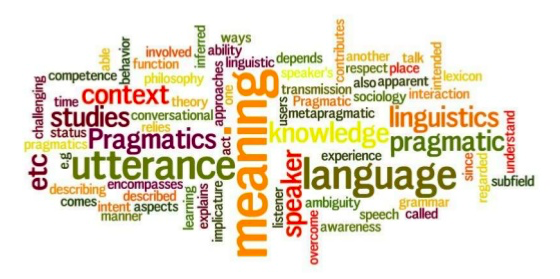
This course aims to familiarize students with basic theoretical and methodological knowledge in pragmatics, namely, the branch of linguistics that studies meaning in context; so-called pragmatic, or utterance meaning.
The course will present and discuss key concepts in pragmatics such as context, deixis, implicature, speech acts, politeness and impoliteness, and humor, and will situate the discussion of these concepts within contemporary pragmatic theory. It will also encourage students to apply such concepts to the analysis of language data in order to acquire an understanding of how verbal communication works.
Ημερομηνία δημιουργίας
Τρίτη 21 Φεβρουαρίου 2023
-
Περίγραμμα
Course Objectives/Goals
This course aims to familiarize students with basic theoretical and methodological knowledge in pragmatics, that is, the study of meaning as communicated by a speaker and interpreted by a listener (so-called “pragmatic, or utterance meaning”). The course will present and discuss key concepts in pragmatics such as context, deixis, implicature, speech acts, politeness and impoliteness, and humor, and will situate the discussion of these concepts within contemporary pragmatic theory. Students are expected to apply pragmatic theory to the analysis of language data, derived from films and TV series, through weekly formative assignments. They will also be encouraged to reflect on their own experience as language users and to recognize pragmatic phenomena in everyday speech events and various text types.
Upon successful completion of the course students are expected to:
- acquire a good understanding of key concepts in pragmatics;
- associate them with different frameworks in pragmatic theory (Gricean pragmatics, Speech act theory, Politeness theory, etc.);
- apply such concepts and theories to the analysis of language data;
- develop an understanding of pragmatic meaning as an integral part of linguistic theory.
Instructors
Dr. Anna Piata
Email: apiata@enl.uoa.gr
Office hours: by appointment (please email me in order to fix an appointment)
Instructional Methods
The course is offered in the form of lectures, which will be uploaded on e-class together with other learning materials, such as articles and book chapters, online resources, and formative coursework. Students are expected to actively participate through in-class discussions and workshop-style group work during class meetings. Classes will also include take-home assignments in order to facilitate, and monitor, students’ understanding of the topics discussed in class. Finally, the course will be evaluated through an evaluation form that will be completed anonymously by the students at the end of the semester.
Assessment Methods
Students will be assessed on the basis of an end-of-term exam. Weekly assignments are only formative and optional.
Course Syllabus
Week 1
Introduction to the course: What is pragmatics?
Pragmatic, or utterance meaning.
Week 2
Deixis. Types of deixis.
Deictic and non-deictic expressions. Deictic projection.
Week 3
Implicatures I. What is said vs what is meant.
Particularized conversational implicatures.
The Cooperative principle and the maxims of conversation.
Week 4
Implicatures II.
Particularized vs generalized conversational implicatures.
Properties of conversational implicatures.
Week 5
Implicatures III.
Conventional implicatures.
Natural vs non-natural meaning.
Week 6
Speech act theory I.
Constatives and performatives. Austin’s felicity conditions.
Week 7
Speech act theory II.
Searle’s felicity conditions. Taxonomy of speech acts.
Week 8
The logic of indirect speech.
Direct vs indirect speech acts. The strategic speaker.
Week 9
Politeness theory I.
The notion of face: Positive and negative face.
Face-threatening acts.
Week 10
Politeness theory II.
Politeness strategies. Cross-cultural variation.
Week 11
Impoliteness.
Face-damaging acts. Impoliteness strategies.
Week 12
The pragmatics of verbal humor. Theories of humor.
The General Theory of Verbal Humor.
Week 13
Wrap up class: Towards a comprehensive account of linguistic pragmatics. Cross-disciplinary perspectives. Exam preparation.
Bibliography
Austin, J. L. (1962). How to Do Things with Words. Cambridge, MA: Harvard University Press.
Birner, B. (2013). Introduction to Pragmatics. (IUB Online resource).
Brown, P. & Levinson, S. (1987). Politeness. Some Universals in Language Usage. Cambridge: Cambridge University Press.
Carston, R. (2002). Thoughts and Utterances: The Pragmatics of Explicit Communication. Oxford: Blackwell.
Dancygier, B. & Sweetser, E. (2014). Figurative Language. Cambridge: Cambridge University Press.
Gibbs, R. & Colston, H. (2012). Interpreting Figurative Meaning. Cambridge: Cambridge University Press.
Grice, H. P. (1989). “Logic and Conversation, Lecture 2”. In Studies in the Way of Words. Cambridge, Massachusetts and London: Harvard University Press, 22-40.
Leech, G. (1983). Principles of Pragmatics. New York: Longman
Levinson, S. 1983. Pragmatics. Cambridge: Cambridge University Press.
Searle, J. R. (1969). Speech Acts. Cambridge: Cambridge University Press.
Sperber D. & Wilson, D. (2015). “Beyond speaker’s meaning”. Croatian Journal of Philosophy 15 (2): 117-149.
Sperber D. & Wilson, D. (1995). Relevance: Communication and Cognition [2nd ed.]. Oxford: Blackwell.
Watts, R. (2003). Politeness. Cambridge: Cambridge University Press.
Yule, G. (1996). Pragmatics. Oxford: Oxford University Press.